Rapid Prototyping & Production
Custom 3D Printing
Services in China
SLA, SLS, SLM and FDM for prototypes and functional parts — then the same team machines it or moulds it when you move to volume.
Get a Printing Quote
Rapid Prototyping & Production
SLA, SLS, SLM and FDM for prototypes and functional parts — then the same team machines it or moulds it when you move to volume.
Get a Printing QuoteA print-only service gives you a part and stops there. The moment your design needs to fit a machined bearing, hold ±0.01mm, or survive 10,000 cycles, you are back to searching for a second supplier — and explaining the whole design again.
We print the prototype and then manufacture the production part in the same building. That means the printed sample is designed with the production process already in mind: draft angles accounted for, wall thicknesses that will actually mould, and critical faces left oversize so they can be machined rather than printed.
The practical difference: a print bureau will give you a part that looks right. We give you a part that also tells you something true about how the production version will behave.
| Process | Material | Typical tolerance | Best for |
|---|---|---|---|
| SLA Stereolithography |
Photopolymer resin — standard, tough, high-temp, clear | ±0.1mm | Fine detail, smooth surfaces, visual models, master patterns |
| SLS Selective laser sintering |
Nylon PA12, PA11, TPU | ±0.3mm | Functional parts, living hinges, small batches, no support marks |
| SLM Metal laser melting |
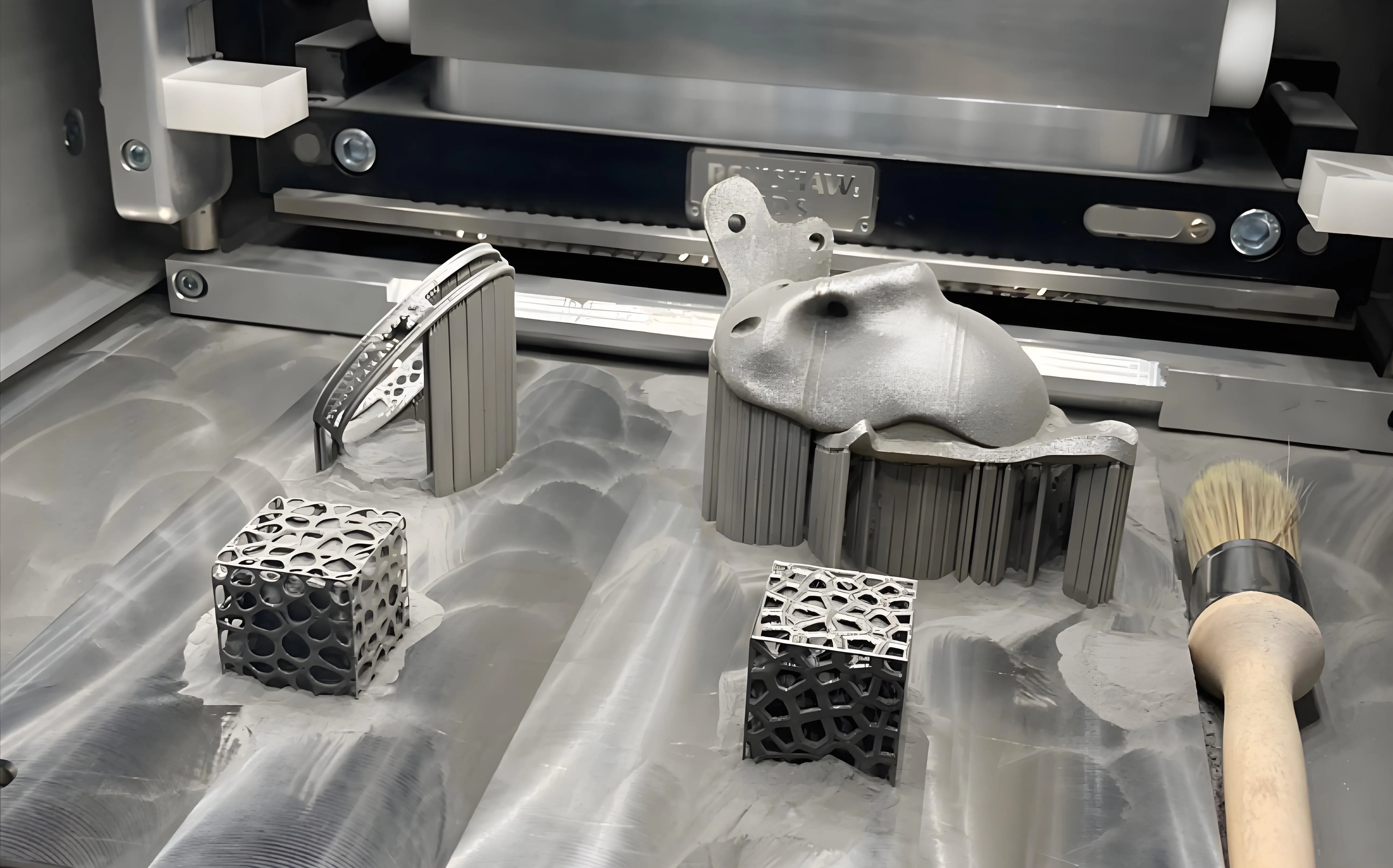
AlSi10Mg, Ti-6Al-4V, 316L stainless | ±0.1mm + machining | Lightweight lattice structures, conformal cooling, complex metal geometry |
| FDM Fused deposition |
PLA, ABS, ASA, PETG, TPU | ±0.5mm | Fast, low-cost form checks, jigs, large simple shapes |
Tolerance figures assume small-to-medium parts. Large parts accumulate error across the build envelope; we quote expected deviation per part rather than promising a blanket number.
Material choice in printing matters more than in machining, because the process itself changes mechanical behaviour — not just the alloy.
Sharp detail and a smooth finish straight off the machine. Brittle compared with thermoplastics and degrades under UV, so it belongs in presentation models and form-fit checks, not in load-bearing service.
Formulated to bend before it breaks. Used for snap fits, clips and housings that will be handled during testing. Still not equivalent to moulded ABS over long-term UV exposure.
The workhorse for functional prototypes. No support structures means no witness marks on undersides, and the parts tolerate impact and repeated flexing. Surface is slightly grainy and needs bead blasting if you want it smooth.
Real metal with real properties. AlSi10Mg suits lightweight brackets and heat-sink geometry; Ti-6Al-4V suits high-load, corrosion-critical parts. Both need stress-relief heat treatment and support removal, and both usually need machining on any surface that has to seal or locate.
Printed parts are not isotropic. A layer is a weak plane, and every additive process builds in layers. A bracket that tests strong when pulled along the flat can fail at half that load when pulled across the layers.
This matters when you hand a printed sample to a customer as a mechanical proof. If the load path runs across layer boundaries, the sample is not representative of the machined or moulded part — and sometimes not even of a printed part built in a different orientation.
We orient parts for the load case rather than for the fastest build, and we tell you when the orientation you would need for strength conflicts with the surface finish you want.
A short decision table, because this is the question that decides your budget.
| Your situation | Choose |
|---|---|
| 1 to ~20 parts, complex internal geometry | 3D printing |
| Needs to hold ±0.05mm or tighter | CNC machining |
| Design still changing week to week | 3D printing |
| Needs specific alloy properties (7075, 17-4PH, Grade 5) | CNC machining |
| Thin walls, lattice, or conformal channels | 3D printing |
| More than ~50 parts of simple geometry | CNC machining |
| Hundreds to thousands, one design | Injection molding |
| Printed shape but machined fits | Print, then machine |
The last row is the one worth remembering. Printing a part oversize and machining only the functional faces gives you complex geometry and real tolerance in the same part, usually for far less than machining the whole shape from solid. See our precision CNC machining capabilities for the tolerances that finishing step can hold.
STL or STEP, plus a 2D drawing if you have critical dimensions.
We confirm which process fits your geometry, load case and budget — and flag what printing cannot hold.
Print, remove supports, bead blast or paint, machine critical faces if specified.
Express the samples, then transition the same design to CNC or moulding.
SLA holds roughly ±0.1mm on small parts, SLS around ±0.3mm, and FDM about ±0.5mm. That is an order of magnitude looser than precision CNC machining at ±0.01mm. If a feature has to fit a bearing, seal a fluid, or mate with a machined surface, it should be printed oversize and machined afterwards — we plan that in during quoting.
Yes, SLM in aluminium AlSi10Mg, titanium Ti-6Al-4V and stainless 316L, arranged per project. Metal parts come off the machine attached to a build plate with support structures, so they always require support removal, stress-relief heat treatment and usually machining on critical faces. We quote that full chain, not just the print.
For low volumes and complex geometry, sometimes yes. SLS nylon is a legitimate end-use material for enclosures, brackets and ducting. What you cannot assume is that a printed part matches the mechanical properties of the same design in machined aluminium or moulded ABS — layer adhesion and porosity change the failure behaviour. We will say so if your application is sensitive to that.
SLA and FDM samples typically ship in 3 to 5 working days. SLS runs 5 to 7 working days because parts need cooling and bead blasting after the build. Metal SLM takes longer, usually 7 to 12 working days including heat treatment and support removal. Rush handling is possible on small quantities.
An STL or STEP file. STEP is preferred because it carries actual surfaces, while STL is a mesh approximation that can hide errors. If you also have a 2D drawing with critical dimensions, send it — it tells us which surfaces need post-machining rather than being left as printed.
Only at low quantity. There is no tooling and no programming, so a single printed part is usually cheaper than a single machined part. The crossover comes quickly — typically somewhere in the tens of pieces for simple geometry — after which machining wins on unit price and gives better tolerance and material properties.
Support removal, bead blasting, sanding, primer and paint, clear coating, dyeing for SLS nylon, and vapour smoothing. Threaded inserts and helicoils can be fitted. Critical bores and mating faces can be machined after printing, which is the usual way to get a printed prototype close to production behaviour.
That is the main reason buyers come to us rather than a print-only bureau. The same team that prints the prototype can machine it in aluminium, or cut a mould and injection mould it, holding the geometry consistent across all three stages. You avoid re-explaining the design to a second supplier.
STL or STEP file, process recommendation and a costed quote within 24 hours. NDA available before you share files.
Request a Printing Quote